 Your Browser is Outdated


For over 60 years, .223 Remington/5.56 NATO was the standard cartridge for AR-15 platforms. The buffet of bullets we have today didn’t exist. If you ran an AR, you were shooting .223 or 5.56 ammo out of it. While several older calibers have been slowly replaced over the years, 5.56x45 is still the most popular cartridge for the AR-15.
Sometimes, manufacturers just get it right the first time. Other times, a new caliber is introduced to meet a growing demand for specific use cases. In comes the .300 Blackout rifle. In this guide, we’ll provide a side-by-side caliber comparison, discuss the benefits and disadvantages of each cartridge, and explain which round is best for specific scenarios.
Why Was 300 Blackout Created?
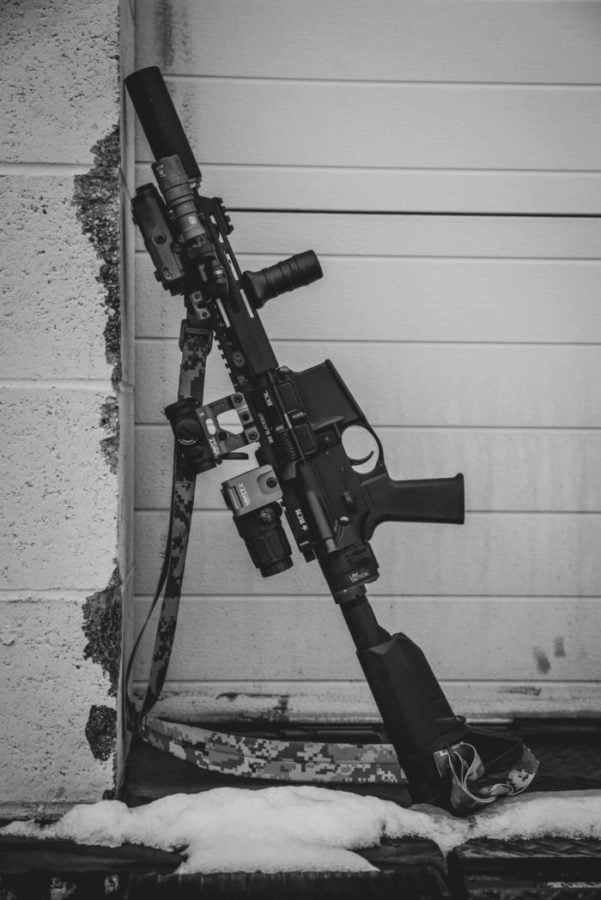 Since 5.56 NATO is so popular, it’s fair to question why a new caliber would need to be created in the first place. The simple answer: the evolution of warfare. By the early 2000’s, the military was increasingly running short-barreled rifles (SBRs) for improved maneuverability and performance in close-quarters combat (CQB) and suppressors for enhanced stealth and improved situational awareness by eliminating loud echoes of gunfire in confined spaces. 5.56 NATO was optimized for longer rifle barrels, not these newer setups.
556 ammo excels with its higher velocity, but this cannot be achieved with shorter barrels. Subsonic 5.56 falls short due to its high pressure and poor cycling. 300 Blackout was designed to fill these performance gaps, resulting in a round that operates effectively with a suppressor and in SBRs while delivering improved short-range stopping power. For civilians, SBRs require an NFA tax stamp and a lot of red tape, so they choose to run 300 Blackout AR pistols instead, which perform just as well.
Best of all, you can shoot 300 Blackout even if you use a 5.56 lower. You can purchase a complete 300 Blackout upper, attach it to your existing 5.56 lower, and shoot 300 BLK with the same bolt carrier group and charging handle. You can also sometimes just swap to a 300 Blackout barrel, but you may need to tune your gas system, especially if you’re running a suppressed setup.
5.56 vs. 300 Blackout: Caliber Comparison
Before we compare these cartridges, you should read our guide on 223 vs. 556 to understand the differences between those calibers and why they are often grouped together.
| Specification | .300 Blackout | 5.56 NATO / .223 Remington |
|---|---|---|
| Bullet Diameter | .308 in (7.62mm) | .224 in (5.56mm) |
| Case Length | 1.368 in | 1.760 in |
| Overall Cartridge Length | 2.26 in | 2.26 in |
| Bullet Weight Range | 110–220 gr | 55–77 gr |
| Muzzle Velocity | 1,000–2,200 fps | 2,700–3,100 fps |
| Muzzle Energy | ~500–1,400 ft-lbs | ~1,200–1,300 ft-lbs |
| Effective Range | 0–200 yards (optimal) | 0–500+ yards |
| Recoil | Moderate | Light |
| Performance in Short Barrels | Excellent | Reduced effectiveness |
| Suppressor Compatibility | Optimized (subsonic & supersonic) | Limited (supersonic only) |
| Typical Use Cases | Hunting (deer/hog), suppressed shooting, home defense | Target shooting, varmint hunting, duty/range use |
| Cost & Availability | Higher cost, less common | Lower cost, widely available |
Now that you understand the basic ballistics of 5.56 and 300 BLK ammo, we can break down their benefits and use cases to help you choose your rifle round.
Pros & Cons of 556 Ammo
Advantages of 556 Ammo
- Higher Velocity: This results in a flatter trajectory optimized for long-distance shooting. If you plan to hunt small game at extended ranges, 5.56 NATO is the round for you.
- Lower Recoil: The 556 uses a smaller bullet which results in less felt recoil. This also allows for faster, more accurate follow-up shots. It is also much easier to control recoil with a 5.56 rifle during rapid fire scenarios.
- Ammo Availability & Cost: Its rich history results in a plethora of ammo options and bullet types. The mass production of the 556 round also decreases costs, so the average price per round is lower than 300 Blackout ammunition.
- Varmint & Small Game Hunting: With fast, flat shooting and light recoil, 5.56 NATO excels at hitting small, distant targets like coyotes and prairie dogs.
- Reduced Risk of Over-Penetration: Compared to 300 BLK, the 5.56 round has much less risk of over-penetrating your target, which is ideal for self-defense scenarios in apartments or other urban environments where that is a concern.
Disadvantages of 556 Ammo
- Poor Suppressed Performance: Perhaps the biggest drawback in comparison, the 5.56 round is not optimized for use with suppressors. Shooting subsonic 556 ammo can result in poor cycling and increased gas blowback (directly to your face, by the way). The drawbacks of shooting 5.56 suppressed outweigh the benefits.
- Not Optimized for Shorter Barrels: Velocity drives the effectiveness of 556, and when you decrease the standard barrel length (usually around 16-20in), the velocity drops significantly. This drop in velocity can also reduce bullet fragmentation, resulting in less immediate energy transfer to your target and smaller wound channels.
- Less Effective on Big Game: Due to its size, 5.56x45 ammo does not possess the terminal performance to ethically take down deer and other large game. It’s even forbidden for such use in a lot of states.
- Reduced Energy Transfer at Close Ranges: Its lighter, smaller bullet diameter requires velocity and fragmentation to succeed. Heavier calibers deliver much better energy transfer at shorter ranges than 556.
Pros & Cons of 300 Blackout Ammo
Advantages of 300 Blackout Ammo
- Designed for Suppressed Shooting: That’s the platform’s whole purpose. Subsonic 300 Blackout ammo is about as good as you can get for suppressed shooting.
- Optimized for Short-Barreled Rifles: On average, a 300 Blackout barrel is around 7-10.5 inches, and the accompanying ammo was designed to excel at this length.
- Strong Close-Range Energy Transfer: Heavier, larger bullets = more momentum and bigger wound channels. Unlike 5.56, 300 Blackout doesn’t rely on velocity to be effective. It possesses incredible stopping power even at lower velocities, perfect for suppressed SBR setups or AR pistols.
- Excellent Deer & Hog Hunting Round: At standard hunting distances of 200 yards or less, the .300 Blackout round delivers ample stopping power and consistent expansion and penetration for ethical takedowns, especially against deer and hogs.
- Great for Compact Home-Defense Rifles: 300 BLK was designed for CQB scenarios, much like you’d encounter during a home invasion. With an easily maneuverable setup and close-range performance, 300 Blackout is great for self-defense. Just keep in mind that over-penetration can be a factor if you live in an apartment or similar arrangement.
- AR-15 Compatibility: If you already shoot .223/5.56, you don’t need a whole new rifle to shoot .300 Blackout. Swapping the upper or barrel can allow you to do so. Just make sure to tune the gas properly if you go with the barrel option.
Disadvantages of 300 Blackout Ammo
- Poorer Long-Range Performance: The 300 Blackout round is optimized for use in an SBR. It’s not optimized for long-rage shooting. The heavier, slower bullet experiences significant drop at extended ranges. If distance is your concern, you’re better off with 5.56.
- More Recoil: The heavier bullet results in more recoil. When swapping to 300 Blackout, make sure to practice until you get the hang of it. If the strong recoil impacts your accuracy enough, it may not be the right round for you.
- Greater Risk of Over-Penetration: This is especially true for supersonic loads. While designed for close-quarters engagement, 300 Blackout is best suited for self-defense in rural areas.
- Higher Ammo Cost & More Limited Selection: It’s tough to compete with the most popular AR-15 ammo of all time. This means the price per round for 300 BLK is steeper, and you’re often picking from a more limited selection. There is still plenty of 300 Blackout ammo around, so don’t let this deter you entirely.
The Short of 300 Blackout vs. 5.56 Ammo
The choice between these calibers is thankfully simpler than other comparisons. If you want a round that excels over long distances, is easily available and generally inexpensive, and offers very manageable recoil, 5.56 NATO is the perfect cartridge for you. If you want to shoot a suppressed SBR setup designed for hard-hitting, close-quarters takedowns, 300 Blackout is the best option out there. OpticsPlanet has one of the largest ammo selections in the industry, offering a vast variety of cartridges at affordable prices. Check out our offerings today and stock up on your favorite rounds for less.
