 Your Browser is Outdated


Finding the optimal optic for your AR is no easy task, especially when faced with the decision between a rifle scope and red dot sight. Do you want to sacrifice versatile magnification for faster target acquisition? How will adding an AR red dot to your build impact your hunting performance? Thankfully, we’re here to address these burning questions and help you choose the best AR optic based on your reasons for owning your firearm, your personal preferences, and budget considerations.
Benefits of AR Scopes & LPVOs
Most AR-15 scopes fall into the category of an LPVO (Low-Power Variable Optic). LPVO scopes start at a true magnification of 1x and can go as high as 10x. On average, a 1-6x LPVO optic has an effective range of up to 300-400 yards, while a 1-8x or 1-10x LPVO scope can range out to 500 yards and beyond. If you need your optic to hit targets beyond 300 yards consistently, the discussion can mostly stop here because an LPVO is the best choice for you. If not, there are some other factors to consider.
Most red dot optics are effective at up to 200 yards, maybe 300 yards if you’re a sharpshooter. The biggest issue with red dots is that the reticle doesn’t scale with your target, meaning that at longer distances, your red dot reticle will cover up much more of your target than the fine reticle of an LPVO scope. Red dots also require battery or solar power to operate, while LPVOs feature an etched reticle that can be seen without external power sources.
As for application, a scoped AR-15 excels in environments where you expect dynamic target ranges. This mostly applies to 3-gun matches where you must tackle a wide variety of target distances. Since speed counts, you don’t have time to swap optics, so an LPVO is the best choice because you can acquire close-range targets with the 1x and dial out to adjust to the course as you progress.
For hunting, an AR rifle scope is best suited for game that tends to remain stationary for the shot, like whitetails. This is especially true for western hunts where you’re shooting at ranges around the 200–300-yard mark. Even when shots are 100 yards or less, you get much more precision to ensure an ethical takedown. Read our guide on What Is an LPVO Scope? to learn more about these optics and their advantages.
Benefits of AR Red Dot Sights
While the above information may lead you to an AR scope right away, AR-15 red dots certainly have their own advantages. Red dots excel at rapid target acquisition, offer a crisp, clear sight picture, and allow for much more maneuverability than a bulkier scope. You can also shoot with both eyes open using a red dot optic, while this is usually only feasible when your LPVO is at 1x magnification, increasing your situational awareness.
While you can find AR scopes and red dots in similar price ranges, you won’t be able to find the same quality at each price point. A high-end LPVO can cost well over $1,000, while a premium red dot sight can be found in the $250-$500 price range, meaning that a luxury red dot sight is much more affordable than a top-tier LPVO. Also, red dot optics have fewer moving parts than an AR scope, so they tend to be much more durable, making them ideal for tactical environments or harsh hunting grounds where your sight will encounter more bumps and bruises during use.
As for hunters, running a red dot sight on your AR is usually the best choice for nighttime outings like hog hunts. For starters, there are tons of red dots with night vision compatibility that allow you to clearly view the dot through a night vision device, and they offer unlimited eye relief which bodes well when wearing bulky NVG. Hogs, coyotes, and other predators are often moving fast in the field, so you need the speed of a red dot to excel in these situations. It’s much more difficult to track fast-moving game with a magnified scope, and you’ll have maximum situational awareness to leap at the best opportunity for a takedown.
Another aspect to consider is if you have an astigmatism, which can impact how you see your red dot reticle. Thankfully, alternatives like a holographic sight can alleviate this because they use a laser to project a 3D hologram of the reticle, which may be easier to see. Prism red dot scopes are another excellent option because they feature etched reticles that you can use effectively without illumination or on low brightness settings.
Other Alternatives & Optical Setups
Choosing between an LPVO or AR-15 red dot doesn’t have to be so straightforward. There are a couple of solutions out there that blend the best of both worlds.
AR Red Dot with Magnifier
There are several red dot sight magnifier combos and standalone magnifiers that can instantly increase your magnification by 3x or even 6x. Red dots offer unlimited eye relief, which results in a variety of mounting options and extra rail space that can easily fit a magnifier. They feature flip-up mechanisms so that you can instantly deploy them or move them out of the way, offering quick versatility in the field. If you prefer faster and simpler target acquisition but want that option to increase zoom level in a pinch, a red dot magnifier is the perfect solution. Check out our Red Dot Magnifier Guides to learn more about these accessories and how to properly mount one on your AR.
AR-15 Scope Red Dot Combo
OpticsPlanet sells several red dot scope mounts that allow you to equip a red dot sight to your rifle scope, and you can even buy combo packages like Trijicon ACOG scopes with RMR red dots and mounts included. This means you don’t have to decide at all between which optic to use until you’re out in the field. However, this does create a bulkier build, and if you’re new to it, it may take some time to nail the exact optic height and alignment you want. There are two ways to achieve this: with a 45-degree offset mount or mounting the red dot directly on the scope.
Using an offset red dot sight takes some practice since you need to rotate the weapon to acquire the sight and fire it that way. However, most marksmen eventually master it after some training. There are also limitations for ambidextrous shooters since you cannot easily change the position in most cases, meaning you’ll need to commit to your right or lefthand side. This is important for tactical operators who shoot from behind barricades and cover since they are limited to only one side with the red dot.
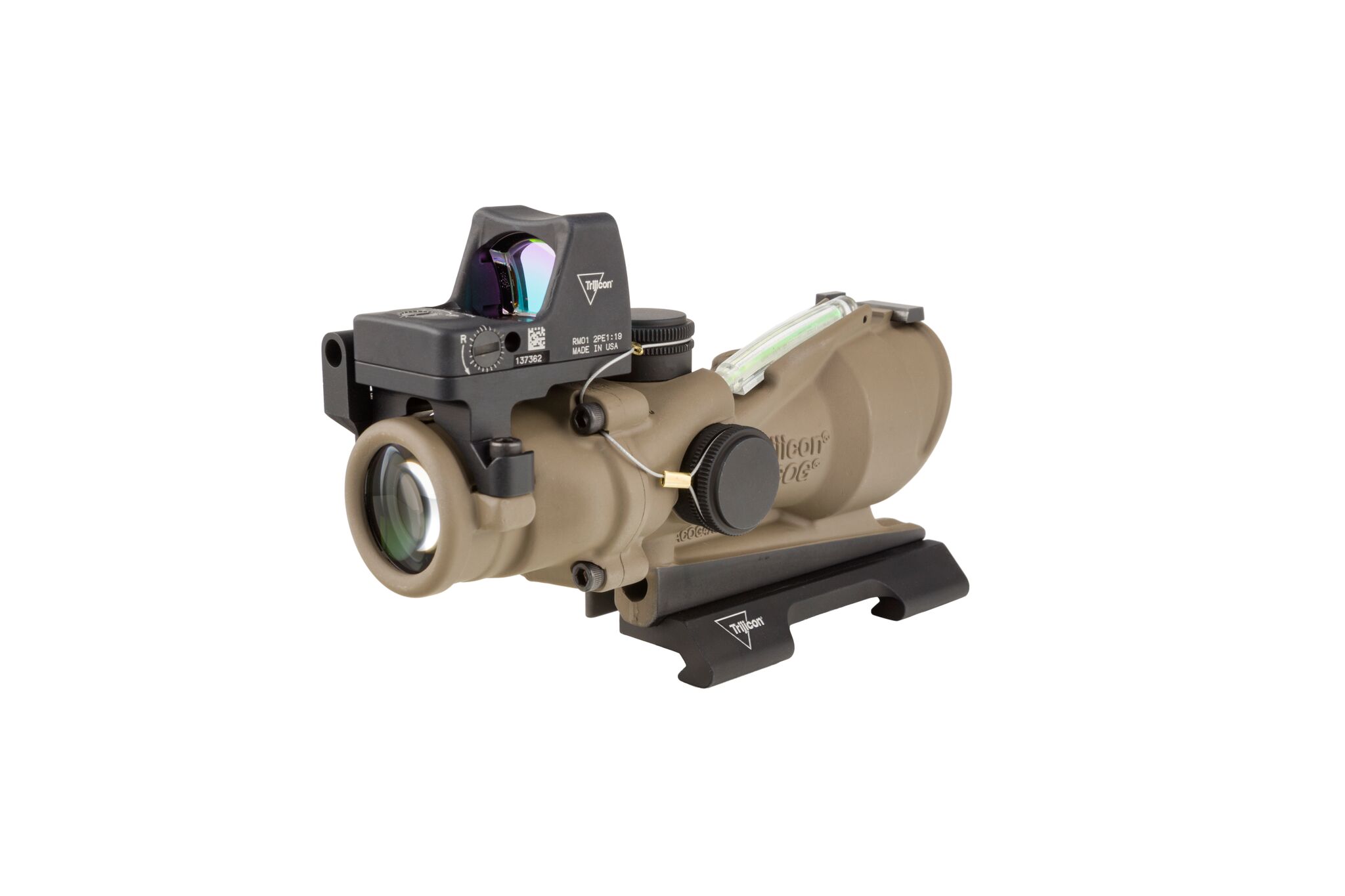
The other option is mounting the red dot on top of the scope, also known as piggybacking it. Instead of turning the rifle, you simply lift your head a bit to acquire the red dot optic. This allows for ambidextrous use, and the height of the red dot makes it more favorable for those who wear night vision goggles. Some folks rely on the red dot for quick target acquisition and switch right to the scope for a precise shot. The downsides of a piggyback red dot mount are that you lose your cheek weld when using the top optic, and the red dot sight is mounted high above the bore, which takes a lot of training to master the holdover for close-range shots.
Shooting Near and Far with Your AR
LPVO scopes and red dot sights both have their pros and cons when it comes to AR builds. Hopefully, you have a better understanding of which optic best suits your needs so that you can find the perfect sighting solution for your rifle. We’re named OpticsPlanet for a reason. With the largest selection of rifle scopes and red dot sights on the web from top brands like Vortex, SIG SAUER, and Trijicon, you’re sure to find a premium optic within your budget. With all the knowledge you need to make a sound decision, browse our optic collection today to elevate your shooting skills with the crispest, clearest views possible.


