Your Browser is Outdated



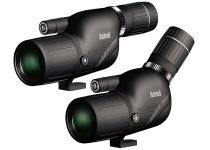 Angled and Straight Spotting Scopes
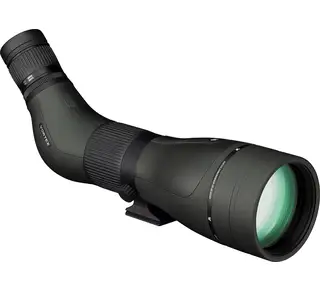
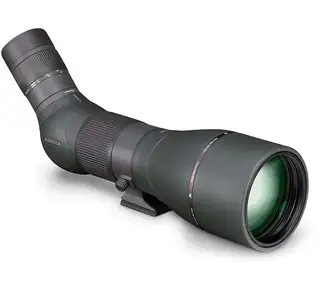
Angled or straight on a spotting scope is a matter of body design, not the eyepiece, as some believe. It is a feature built into the body. You cannot convert an angled body scope into a straight or vice versa by changing eyepieces or adding adapters. You must choose this feature up front when you buy a spotting scope. That said, there is no wrong choice, here, just a matter of some advantages and disadvantages. In the end, it as much a matter of personal preference, as any. The majority of serious birders, by a slim margin, use angled but go with what works for you. I have both.
Straight bodied spotting scopes are easier to line up on target for beginners and also balance nicer if you attach a heavy SLR camera on the back for photography. Straight bodied spotting scopes are also a better choice for looking down at objects, as you might from an elevated blind of observation tower. Straight bodied spotting scopes are also much easier to handle and use when viewing from a vehicle with a window mount.
Angled bodied scopes are more comfortable to look through for longer periods of time, since you are not squirming down to look through the eyepiece. Angled bodies spotting scopes are also more stable, because they can sit lower on the tripod. Angled scopes are also easier on the neck when looking at objects at an elevation, as in birds in distant trees or mountainside. Lastly, angled bodies scopes, if supplied with a tripod collar (a ring around the center of the scope that allows the scope to rotate while on the tripod) and are a better choice if you are sharing the scope with people of different heights, since you can adjust the eyepiece to the side for shorter observers.
Focus
For the same reason as using a zoom eyepiece - speed - a spotting scope that focuses, quickly, can be a real advantage for birding, especially if you are viewing birds at varying distances. Most bird scopes are, in fact, small refractor telescopes and focusing speed is rarely an issue with this design. On the other hand, there are other telescope designs sometimes offered as spotting scopes, namely Maksutov-Cassegrains (Maks) and Schmidt-Cassegrains (SCTs). Be warned that these designs are very slow to focus and are thus marginal choice for birding. These 'telescopes' type spotting scopes do offer the advantage of easily changed eyepieces, but the telescope zoom eyepieces that fit in these models invariably produce too much magnification to be practical for a spotting scope.
Waterproofing
Birders are less likely to use spotting scopes in severe weather than, say hunters, but a waterproof spotting scope is still recommended, since a waterproof model is also better sealed against dust and dirt. This is actually a non-issue, though, since nearly all spotting scopes, these days, with the exception of a few inexpensive models, re waterproof, anyway. Check the specs to be sure.
Cases & Tripods
Many spotting scopes include or offer as an option, a "view thru" or "field" case that allows you to use the spotting scope with case installed, usually by means of flaps that fold back on front and back of the scope to expose the objective and eyepiece. The idea, here, is added protection. Note that these are very model specific accessories and must be an exact match for model of spotting scope, even to the point of specifying angled or straight. In short, there is no interchangeability between models when it comes to a field case. However, I don't regard a field case as an essential item. Many birders are religious about using one, but I, personally, find them to be annoying and use the case, instead, for protection during transport. Mine usually stays in the car. Each to their own.
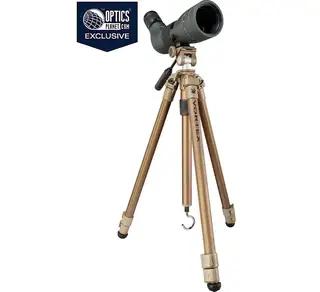
As always, any spotting scope can attach to any photo tripod, but that does not make just any photo tripod a good match in terms of performance. The best spotting scope in the world is only as good as the tripod under it, so do not be tempted to cut costs with this important accessory. Bottom line is that there is no such thing as a good tripod under $100 and it only takes one session with a rickety, cheap tripod to learn this truth. Keep in mind that the larger the spotting scope, the heavier the tripod needed to support it, adequately. For 60mm class spotting scopes, the Nikon 848 or a Bogen kit (must say kit) with the 700RC2 head will work. For 80mm class spotting scopes, I strongly recommend a Bogen tripod kit with either the 128RC head or the 710RC2 head.
Most birders use a two way "video head" on their tripod, which offers simple right-left and up-down adjustments. These offer maximum stability and balance, since the head sits lower on the tripod. Some birders like ball heads and a ball head does allow you to move the scope, quickly, in any direction, but that comes at the price of stability and weight, since a ball head places the spotting scope higher off the tripod and to be effective with a large spotting scope, you must use a heavy, large ball head. A small ball head is a disaster with an 80mm spotting scope.