 Your Browser is Outdated




Battery Power
Contrary to popular belief, alkaline batteries are not obsolete. While they are larger in size, weigh more and do not have the shelf life of the popular disposable lithium batteries, alkaline batteries still work as well as they ever have. Any alkaline battery powered flashlight will serve perfectly when a circuit breaker trips or the power goes out at home. An alkaline powered LED flashlight can last for days. That being said, there are alternative power sources such as rechargeable NiCd, NIMH, or lithium ion batteries that might better serve your purposes, so consider the amount of power you need and for how long when buying your flashlight.
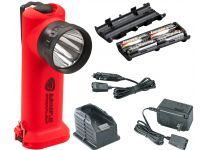 Streamlight Survivor LED Flashlight
Three volt lithium disposable batteries provide more power in a given size than alkaline batteries. It would take about 2.5 alkaline batteries to match the power output of one lithium battery, and one lithium battery weighs about half as much as an alkaline. Lithium batteries also maintain fairly constant voltage for up to 95% of their life. This contrasts with alkaline batteries, which drops voltage at higher discharge rates due to their composition. Lithium batteries have very low internal resistance with their more modern composition, which is ideal for heavy loads.
Disposable batteries generally offer longer run times for a given bulb power than rechargeables and are typically lower in initial purchase price. It's also easier to keep spares on hand. Unfortunately, long term operation costs are considerably higher with disposable battery lights they are seldom as bright.
Rechargeable flashlights have extraordinarily low operating expense and are well suited to frequent use. They can often support a brighter bulb or LED and store conveniently in custom charger holders. The initial purchase price is usually higher and they self-discharge at a higher rate when in storage, but for long term use rechargeable lights offer significant savings over disposable battery lights.
Size
Battery size mostly dictates the size of the flashlight. If you want to buy a smaller flashlight, you're going to get a light with a smaller battery. Large rechargeable wall mounted flashlights powerful enough to push light through heavy smoke are used by firefighters not only because of the intensity of the beam, but because they are used every day for long periods of time. Size is not a primary concern. Many of these top flashlights are also rated for use around explosive gasses and vapors due to the rugged and reliable seals used in their construction.
Composition
Two schools of thought, take your pick. Metal is stronger. Is it? Metal is heavy and can crack, whereas plastics have resiliency. Metal gets cold, whereas plastic feels less cold. Metal may spark and be magnetic. Old school prefers metal, but many of the most durable and popular pistol frames are some kind of proven plastic material. The choice is up to you. Pick a flashlight with either material for your own reasons.
Cost
Any flashlight is fine for light duty use. If it's a work light and swims in a toolbox full of wrenches you should spend a bit more for durability. Some manufacturers make lights that are simply overbuilt for most purposes, but if you're in harm's way like our soldiers, what price can you put on safety? Deer don't shoot back at people, and buildings aren't getting dropped on hunters in the woods, so a sportsman can get by with a lot less than a U.S. Marine in Iraq. Remember, the initial cost of a rechargeable flashlight is higher than a disposable battery light, but in the long run, especially if it's used a lot, it's significantly cheaper.

