 Your Browser is Outdated


Whether you are a bowhunter or target shooter, there are many factors when choosing the right arrow depending on your shooting type. We have created a guide with help from our friends at Easton to break down the various aspects of arrow selection for target shooting and hunting to help you choose the best type of arrow to fit your needs. 
Arrow Spine
Static Spine
An arrow’s static spine is the measurement used to determine the stiffness or flexibility of an arrow shaft. It is calculated by measuring the deflection (bending) of the arrow when a specific weight is applied to the middle of the shaft. A lower static spine number indicates a stiffer arrow, while a higher number indicates a more flexible arrow. The static spine is used to ensure that the arrow is properly matched with the bow and the archer's draw length and draw weight to achieve optimal performance and accuracy.
Dynamic Spine
An arrow's dynamic spine refers to how the arrow flexes or bends when it is shot from a bow. The dynamic spine of an arrow is affected by a number of factors, including the bow's draw weight and draw length, the arrow's length and weight, and the shooter's form and technique. An arrow's dynamic spine is important because it affects the arrow's flight characteristics, including its straightness, stability, and accuracy. To achieve optimal performance and accuracy, it is important to match the arrow's dynamic spine with the bow and the shooter's draw weight and draw length.
Arrow Straightness
Does a thousandth of an inch matter? If you are talking to an archer, the answer is a definitive yes. To the naked eye, most probably would not be able to tell the difference between a thousandth of an inch of an arrow shaft, but it can make all the difference in the world in terms of flight. Arrow straightness measures how much an arrow deviates from perfect as it is turned. Arrow straightness is measured as +/- .003 inch or +/- .005 inch, etc. That means an arrow will deviate by as much as .003 inch or .005 inch in either direction from perfectly straight as you turn it and still be acceptable.
-
Good: 0.006" - sport straightness
-
Better: 0.003" - a mid-straight arrow shaft
-
Best: 0.001" - match-grade straightness. The straightest possible arrow you can get.
Arrow Materials
 Carbon Arrows
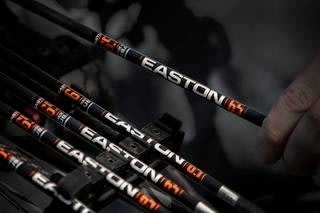
Carbon arrows are lighter, faster, and penetrate better due to their smaller diameter. The arrow weight and fiber strength of carbon arrows make them a favorite for recreational and professional archers. Carbon arrows are highly durable and return to their original shape when they bend, so they stay straight. The flip side of having a lightweight arrow is that the bow has a loud string twang and more kinetic energy.
Aluminum Arrows
Aluminum arrows are similar to carbon arrows in straightness and weight. Aluminum arrows are quieter when shot from a compound bow. Aluminum arrows also offer a broader range of spines.
Aluminum/Carbon Arrows
These hybrid arrows incorporate the best qualities of carbon and aluminum. The smaller diameter and thick carbon wall in the middle provide uniform arrow flight, spine, straightness, and increased penetration. These arrows are also highly durable.
Wood Arrows
Wooden arrows are cost-effective, making them great for new archers. The con to using wooden arrows is that they don't last long because they are prone to breakage, warping, and splintering.
Arrow Diameter
Arrows with a small diameter shaft enable increased penetration due to a smaller surface area and increased friction behind the broadhead. This allows your arrow to maintain momentum for an extended period.
The skinnier the shaft, the better surface to pass through the animal (more penetration). As you drop down in diameter, the higher the price goes. They still enable you to preserve kinetic energy due to increased wall thickness. They also allow you to use more weight up front to improve flight characteristics and long-range accuracy.
 Fletchings
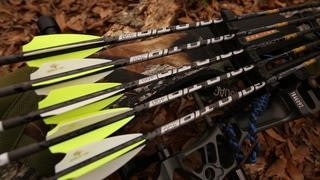
When in flight, fletchings stabilize the arrow. They come in two materials: feathers and plastic vanes. Vanes are durable and waterproof and are used with compound bows and modern recurve bows with an elevated arrow rest. When you need more stability, feathers are an excellent choice. Feathers are preferred for traditional archery and competitive archery during indoor tournaments. When an arrow is launched from a recurve or longbow, its fletching contacts the bow. Feathers are supple, flatten out of the way when contacting the bow, and won't disrupt the arrow's flight. Feathered fletchings are not waterproof but can be made water-resistant with powders and sprays.
The length and design of your fletchings are another consideration. A shorter low-profile vane is suitable for shooting outdoors and longer distances because they have less wind drift and drag. A longer vane with a higher profile is a good choice for indoor archery or if you're not shooting long distances outdoors.
Arrow Length vs. Draw Length
Your draw length obviously will influence the length of your arrows. It's common for archers to assume that draw length equals arrow length when shooting a compound bow, but it's best to think of the two measurements as being related to each other but not married. A good rule of thumb is to cut it no shorter than the middle of the riser. At full draw, your arrow end would sit right in the middle of the shelf, which is located on a bow's riser directly above the grip where the arrow rest is mounted.
Shop Hunting Arrows at OpticsPlanet!
At OpticsPlanet, when we're not in the office, we can usually be found enjoying the outdoors just like you. We have a great selection of compound and recurve bows, arrows, broadheads, and archery equipment! Whether archery is a new hobby or you've been enjoying it for years, check out our other Archery Guides!


