 Your Browser is Outdated




Sighting in a scope is a process that is necessary to get a rifle and its optic tuned for accuracy. In this article, we'll cover how to sight in a scope, how to adjust a rifle scope, sighting in at 25 yards, and how to zero a scope.
Zeroing a rifle scope is the act of aligning your POA ("point of aim", what you're aiming at) and your POI ("point of impact", where the bullet fired out of your gun is hitting) at a specific distance. The reason behind aligning your POA and POI is simple: it allows you to fire a shot at a known distance and accurately hit where you're aiming at the target, animal, etc.
Whether you're new to firearms or just someone that wants to brush up on the right way to dial in your scope or red dot sight, we're going to give you the ins and outs of zeroing an optic to your rifle.
IMPORTANT: Please make sure you always follow the four rules of firearms safety, especially when using this guide.
Step 1: Mount Your Scope
While sighting in a rifle is not overly difficult or complicated, the accuracy of your firearm and scope combination all comes down to how well you installed your scope to the mount and attached it to the rifle. It is STRONGLY recommended to perform a quality mount job on your optic. If you want to double-check to make sure your scope is installed correctly, take a look at our in-depth How to Mount a Riflescope video below.
Along with how well you mount the scope to your firearm, purchasing a subpar optic will also leave you with an inaccurate rifle setup since you'll frequently need to do a rifle scope adjustment on your turrets due to elevation and windage.
Step 2: Getting on Target
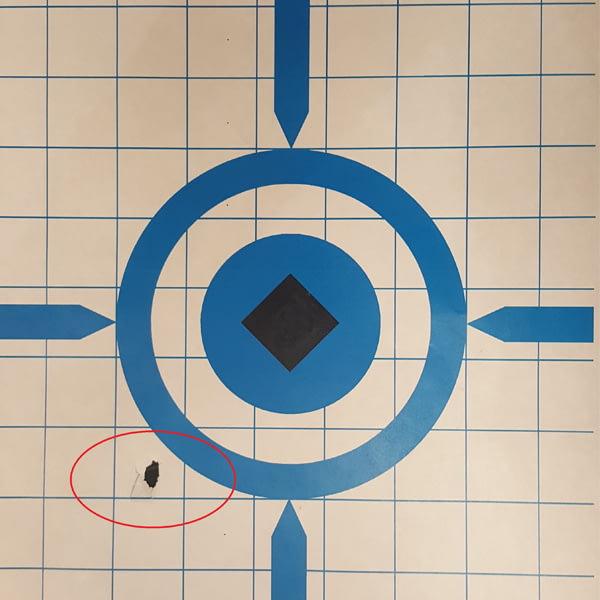
Ok, your scope is mounted correctly, and now it's just you, your rifle, and some ammo at the range. If this is the first time that you're firing the rifle it's best to take 10-20 minutes and dry fire your gun to get a good feel for the trigger. The last thing you want to do is mistake a poor trigger pull for a shot and then make a scope adjustment off of that.
Once you've gotten comfortable with the trigger on your rifle, it's time to set a distance to zero your scope. What distance should you zero a rifle scope? Most manufacturers suggest zeroing at 100 yards, so that's what you're going to do.
*If you prefer to do a 25-yard zero, see the formula in the next section, but it won't change the steps we're covering.
Take a target like the one seen in this guide and position it at the 100-yard line. To get consistent and accurate shots, a rifle bench rest or sandbags are a must. It is also highly beneficial to have a spotting scope next to you focused on the zeroing targets you're shooting at.
While aimed at the dead center of the target, take two controlled shots. More often than not, these first shots are going to be somewhere in this lower left area.
Step 3A: Zeroing a Rifle Scope Alone

If you're zeroing alone, this is the best way to get your scope dialed in. If you have a friend with you, skip to Step 3B.
Assuming that you have a spotting scope or can see the bullet holes that you just punched in your 100-yard target, you need to figure out how many squares up/down and left/right you're off from the bullseye. Luckily the target we gave you at the beginning of this guide makes that relatively simple because every square is exactly 1 inch.
A vast majority of rifle scopes are adjusted in Minutes of Adjustment (MOA) increments, so you need to figure out what value each click on your turret is. On most rifle scopes, including the one pictured in this guide, each click is equivalent to 1/4 MOA at 100 yards.
Since the first two shots are low and left of the center of the target, we know that we need to crank the windage and elevation knobs where we want the bullet to impact. Based on this target, you can see we need to go two squares to the right and two squares up. Because every square represents 1 inch and 1 inch is more or less equal to 1 MOA at 100 yards, if we were shooting at 100 yards it would be simple. Eight clicks to the right on the windage knob (1 click=1/4 inch at 100, 4 clicks = 1 inch, we are 2 inches off the centerline = 8 clicks) and eight clicks up on the elevation knob.
After you've done this, relax, get settled, and take two more well-placed shots at the center of the target. You should be right on. If not, turn the appropriate windage or elevation knob in the direction and click adjustment for where you need your shots to hit.

From there, we're going to want to set this as the new "zero" on the scope. Depending on the particular scope, this might require you to loosen a screw on top of the turrets or pull out on the knob and align the "0" with the line at the rear of the turret. Always refer to the manual for your rifle scope on how to do this correctly. At this point, you can screw on your turret caps if you have capped turrets.
We also strongly suggest taking several shots at a clean target for that extra confidence that your scope is set up perfectly.
*If you're going to be sighting in at 25 yards for 100-yard zero, refer to the easy-to-use formulas below to calculate MOA adjustment at your chosen distance.
How to Adjust a Rifle Scope Formula:
- (Distance to target in yards) / (100) = inches per MOA at that distance
- (Number of inches of adjustment needed) / (inches per MOA at that distance) = MOA adjustment
- (Number of clicks per 1 MOA on scope) x (MOA adjustment) = adjustment in clicks on scope
- For example, sighting in a rifle at 25 yards for 100 yards:
- 25/100 = 0.25 inches per MOA
- 0.25/25 = 6.25 MOA adjustment
- (Number of clicks per 1 MOA on scope) x 6.25 = adjustment in clicks
Step 3B: Zeroing a Scope with a Spotting Partner
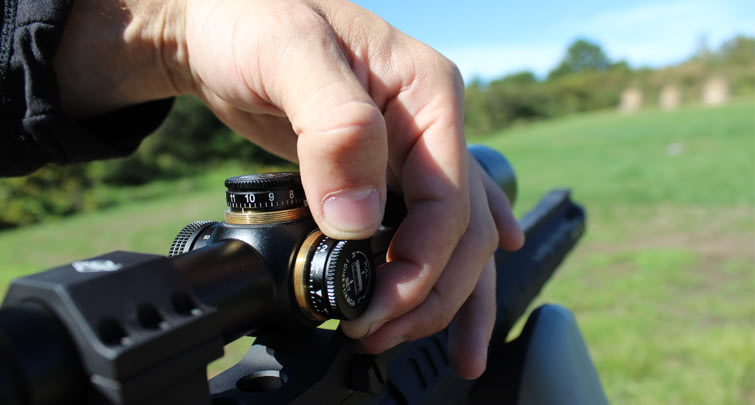
If you're lucky enough to have someone with you at the range when dialing in your scope, it'll save you time and a few extra rounds of ammo, too.
Now you've already taken two shots on paper at 100 yards, and they've punched one big hole about two squares low and two squares left of the center of the target. Normally we'd revert to Step 2 in this guide and through a series of simple math equations, figure out how many clicks to turn the turrets, but you have an extra set of hands that are going to make it a lot easier.
Making sure to really hunker down on the rifle to prevent movement and aim at the dead center of the target. While doing so, you're going to have your friend delicately move the turrets. In our case, the bullet holes are roughly 2 boxes down and 2 boxes to the left, so you're going to have your friend turn the turrets in the direction that you need the next shots to go. Keeping the rifle extremely steady and aimed at the center, have them start clicking right on the windage knob until your crosshair aligns vertically with your bullet holes. After that, have them click the elevation knob upward until your crosshair lines up horizontally with the bullets' holes. Now, aim at the center of the target again, fire a shot, and you should be right on the money.
From there, we're going to want to set this as the new "zero" on the scope. Depending on the rifle scope, this might require you to loosen a screw on top of the turrets or pull out on the knob and align the "0" with the line at the rear of the turret. Always refer to the manual for your rifle scope on how to do this correctly. At this point, you can screw on your turret caps if you have capped turrets.
Just like dialing in when you're alone, we strongly suggest taking several shots at a clean target for that extra confidence that your scope is set up perfectly.
Step 4: Zeroing Ballistics Beyond 100 Yards
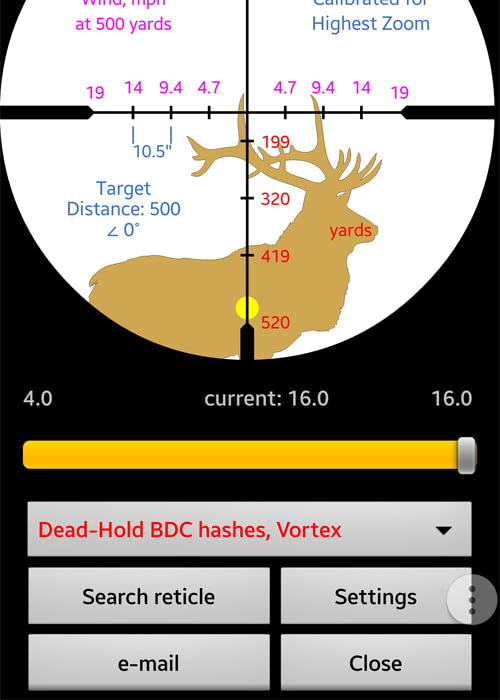
You're not out of the woods yet!
Okay great, you're dead on at 100 yards, but do you plan to only shoot at 100 yards? Depending on what rifle scope you're using, it might feature a BDC-type reticle with bullet drop holdover stadia marks for making shots at varied extended distances. Most of the main rifle scope manufacturers like Vortex, Leupold, Sig Sauer, etc. have some sort of ballistic calculator to help you figure exactly what your round does, not only at different distances but during less-than-optimal weather conditions as well. Sig Sauer BDX scopes and optics are the perfect example of such technology.
If that isn't enough for you, there are quite a few standalone ballistic software applications out there that are easy to use and available on iOS and Android platforms. It doesn't matter which route you decide to go to figure out the ballistics of your rifle and scope setup; the point is that you do it.


