 Your Browser is Outdated


OpticsPlanet's selection of knives are built to the highest standards for folks that demand a knife be much more than a piece of metal with a sharpened edge. Each knife is crafted with blades for the buck hunter who needs hard steel that's easy to clean and a controllable point, the police officer who puts his life on the line every day, and for the woodsmen who knows more than anyone that a poor-quality blade can mean life or death when out in the backcountry. Before you pull out your wallet, take a look at our infographic to determine what knife blade is right for you.
What Are the Parts of a Knife?
The parts of a knife can be divided into two major components: the blade and the handle.
The blade can be broken down into five parts:
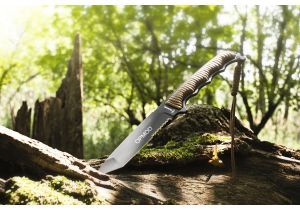
- Point: This is the portion of the blade where the edge and spine meet. This part is generally used for piercing and is the easiest part to damage.
- Tip: The tip of the knife is usually considered to be the first third of the cutting edge, which includes the point. This region is used for fine work and delicate cuts. The tip is also used as an anchor during fine chopping. This part of the knife gets about 60% of action while in use.
- Spine: The spine or knife back, usually refers to the full thickness portion of the blade or the outermost back of the blade. This is the opposite side of the cutting edge and is the thickest portion of the blade. The spine is used for batoning and striking magnesium/ferro rod for fire-starting.
- Serrations: Serrations are located on the blade of the knife which can be fully or partially serrated. A semi-serrated blade is best for field use because it can cut wet objects such as rope, scraping sticks, and bark far better than a plain blade. A serrated blade also makes quick work of cordage and cardboard materials. Typically, the serrated parts are difficult to sharpen but last longer than a smooth blade.
- Jimping: This is a series of notches down the spine of the blade that are created to provide additional grip on a knife. Not all knives have these thoughtfully placed grooves, but they are great for providing traction during stabbing or slicing motions.
The handle can be broken down into four parts:
- Choil: This is the end of a knife's cutting edge that is near the handle. It is a rounded area of the blade that is designed specifically to give the user additional control of the knife. On some folders, it can be to keep the knife from closing on the user's finger or hand if the lock fails.
- Tang: You'll see a lot of references to tang in the descriptions of many types of knives: full tang, half tang, rat-tail tang, but what is the tang? It is basically the extension of the metal that extends into the handle connecting both peices. Almost always a full tang is preferred because the knife is one solid piece and gives the knife additional strength, stability, balance, and durability.
- Handle: This is the material that surrounds the tang where the knife is held. This can be made of several different materials such as fiberglass reinforced plastic (FRP), Aluminum, Titanium and the extremely robust G10.
- Pommel: This is usually a metal cap at the end of the handle on the opposite side of the blade. They can be used to lock a blade into the handle by securing to the blade's tang. These can appear flat and serve at the "butt" of the knife or come with hole perfectly sized for adding attachments, such as paracord.
Different Types of Knife Edges
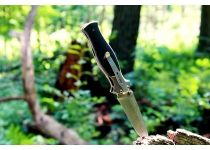
Grind refers to the shape of the cross-section of the blade and is all about the edge. This involves removing significant portions of the metal by sharpening the blade. An appropriate grind will depend on what the blade is used for and what type of metal it is made with. Different knife grinds have different qualities that include strengths, weaknesses, and preferred uses. We are here to talk you through the different types of knife grinds.
- Hollow: Hollow grind blades have been popular amongst hunting and sporting enthusiasts. The thin, long, and sharp edge is ideal for field dressing animals and for this reason, has had a long history of use amongst hunters. Hollow grind has a characteristic concave grind to the edge, so that both sides of the knife have a bevel that bows inward until they meet at the point. The product is a thin and extremely sharp point and edge. The downfall is that this needs constant maintenance, is not very durable, and loses its edge easily.
- Flat: Flat grinds are considered to be the simple edge with a classic "V" shape. The flat primary grind is continuous all the way from the spine and both sides taper towards each other until they meet to form a point. This thin edge is ideal for cutting, slicing, and chopping, with plenty of metal to back the edge for stability.
- Chisel: Chisel ground blades have a single bevel on one side of the blade, and the other side is completely flat. The chisel will start about mid-way between the spine and edge and then taper in a straight line towards the edge to create the point. The chisel grind blade is often found on modern tactical knives.
- Scandi: Also known as the Scandinavian Grind, Scandi grinds have a wide flat bevel that runs to a point at the edge of the blade. Since there is no secondary grind and the knife is not held up at an estimated angle, this type of edge is simple and easy to sharpen. This type of edge provides excellent control when cutting.
Fixed Blade Knife vs. Folding Knife

Carrying a knife on you every day is practically a no-brainer, but you need to think about what capabilities you're willing to sacrifice in favor of comfort and vice versa. Some knives are better than others at giving you the best of both capability and portability, but we've yet to see a perfect blend. It's up to you to decide which is better for your application, fixed blade or folding?
Fixed Blade: When strength is your highest concern, a fixed blade knife is for you. The blade material runs continuously from tip to pommel and creates one tough tool in your hand.
Folder: Slip it in your pants pocket, not a problem. However when you trying to split wood with it by using a batoning method, you'll quickly break the knife. Not known for their tough as nails strength, folding knives are more than capable to handle your daily utility tasks as well as self-defense applications.
What Are The Different Types of Knife Blades?
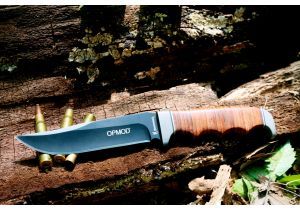
Tanto: I try to tell people the best way to remember what this blade is used for is "Tanto=Tactical". To be honest, that is what the blade shape excels at. The reinforced point was created to pierce through a wide range of materials with relative ease. Plus, it has the added benefit of looking really cool.
Drop Point: They should just call this blade the backcountry blade because it blows the other shapes out of the water when it comes to performing those nitty gritty outdoor tasks. The deep belly also aides in carving and skinning chores. However, it is not the best at stabbing or piercing duties.
Spear Point: You know that old saying "you can't have your cake and eat it too"? With the spear point, you get the best parts of the Tanto and Drop Point in one equally useful blade shape. The problem with this design lies in the overall strength of the tip. Because this shape lacks a thick spine, it is inherently easier to damage.
Clip Point: The best way to label this design is that it's a drop point with a little more "tactical" flare to it. Spawning from the days of the Alamo, the clip point is commonly referred to as a bowie knife. The somewhat exposed tip makes it a good stabber but still has that deep belly for your utility work and skinning applications.
Make sure to check out our guide on the 13 Types of Knife Blades to learn more about other blade types that may be best for your needs.


