Your Browser is Outdated


A spotting scope is a must-have optic for Western big game hunting, elk hunting, and other outings that require high magnification and steady views. While entry-level spotters exist, high-quality spotting scopes like the Vortex Razor HD cost a pretty penny, and while the investment is certainly worth it, you need to ensure you choose the best spotting scope for the money that meets all your needs. Some folks start by deciding what magnification and level of detail they require based on the type of hunting they’ll do. After that, some hunters whittle down their options to reputable brands like Kowa or Leupold.
Even if you easily narrow your search to the exact magnification, optical quality, and brand you prefer, you’re still left with one of the biggest decisions: a straight or angled spotting scope. In this guide, we’ll break down the differences between these types of spotting scopes and weigh their advantages and disadvantages to help you find the best spotting scope for your next hunt.
Straight vs. Angled Spotting Scopes at a Glance
Before we dive into specifics, it’s important to note that the straight vs. angled spotter debate is mainly about ergonomics and design, meaning that this choice doesn’t impact optical quality—just how you pack, set up, and use the optic. Here is a quick comparison to help you better understand the differences:
| Feature | Straight Spotting Scope | Angled Spotting Scope |
|---|---|---|
| Eyepiece position | In line with the scope body | Angled upward, typically around 45° |
| Best for | Fast target acquisition, mobile hunting, vehicle/window use, prone viewing, downhill glassing | Extended glassing, mountain hunting, steep uphill viewing, seated/standing use |
| Target acquisition | Faster and more intuitive | Takes some practice |
| Long glassing sessions | Good | More comfortable |
| Steep uphill viewing | More difficult | Excellent |
| Steep downhill viewing | Excellent | Can be less comfortable |
| Tripod height | Usually requires a taller tripod | Works well with a shorter tripod |
| Tripod stability | Taller setup may be more susceptible to movement | Lower setup can offer greater stability |
| Vehicle/window use | Excellent | More awkward |
| Sharing between users | Requires more tripod-height adjustments | Easier for users of different heights |
| Packing | Streamlined and generally easier to pack | Slightly more awkward shape |
| Digiscoping | Works well; particularly convenient for horizontal/downhill viewing | Comfortable for seated digiscoping |
| Weather exposure | Eyepiece generally better protected from precipitation | Eyepiece more exposed to rain/snow |
| Learning curve | Very intuitive | Requires some adjustment to viewing angle |
| Best overall for | Hunters prioritizing speed, simplicity, and mobility | Hunters prioritizing comfort, versatility, and long-duration glassing |
Straight Spotting Scopes for Hunting
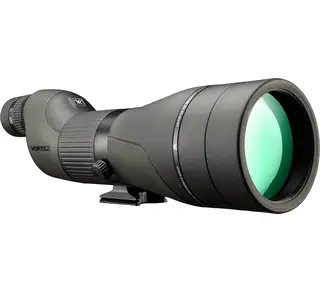
A straight spotting scope is exactly what it sounds like. The eyepiece is directly behind the objective lens so that you look straight through the scope towards whatever you’re observing. Here’s an overview of the benefits and drawbacks of straight spotting scopes compared to their angled counterparts.
Pros of Straight Spotting Scopes
Intuitive Design: Straight spotters are just like most optics that hunters are familiar with like rifle scopes and binoculars. You look right in the direction of your target when glassing.
- Faster Target Acquisition: It's generally easier to get an animal into view because your eye, scope, and target are all aligned, unlike with angled spotting scopes.
- Optimized for Vehicle-Based Hunting: When paired with a window mount, straight spotting scopes excel at glassing from trucks or other vehicles. An angled spotter is awkward and sometimes improbable to use in such situations, but a straight spotter allows you to look directly out the window, turning your vehicle into a mobile spotting station.
- Easier to Glass While Prone: Since you look straight through the scope, it is much easier to use while lying prone since it aligns with your rifle optic. You can tilt an angled spotter for simple glassing, too, but it is less intuitive and requires a bit of practice before it feels comfortable.
- Better for Glassing Downhill: When above the area you’re observing, straight spotters are more comfortable to use since you keep your head and neck in a natural position while looking downhill.
- Easy to Switch from Binoculars to Spotter: Especially when mounted on a tripod, it’s much easier to swap optics since your line of sight remains essentially the same. An angled spotter requires you to view the target from a different position, which may take time for first-time users to get used to, providing an escape window for your prey.
- Simple to Pack: The straight design is often much easier to place in a pack with your other hunting gear. Angled scopes are more awkward to pack because the angled eyepiece creates a less uniform shape.
Cons of Straight Spotting Scopes
- Difficult for Viewing Uphill: Certain types of hunting, especially Western and mountain hunts, require you to observe from steep upward angles. Viewing at such steep angles is difficult with straight spotters since you need to align with the eyepiece and crane your neck, while angled spotters allow you to do this in a more natural position.
- Requires Taller Tripod: A straight spotting scope needs to be level with your eye, requiring a taller, larger tripod for use. Taller tripods add more bulk to your hunting gear loadout, which is especially taxing during mobile hunts. Also, taller tripods sacrifice some stability since wind and accidental contact has a greater impact on movement. At high magnifications, even the slightest movement will disturb the image.
- Less Convenient to Share: Adding to the above point, straight spotting scopes are more of a hassle to share with other hunters unless you’re nearly the same height. You would have to adjust the tripod each time you swap to best match the eyepiece with the user’s line of sight.
- Not Ideal for Digiscoping: If you want a spotter for both hunting and capturing videos and images, an angled scope is your best bet. With a spotting scope phone mount, your device’s camera aligns with the eyepiece. This makes viewing the phone much more difficult unless you are observing straight ahead on flat terrain.
Angled Spotting Scopes for Hunting
On an angled spotting scope, the eyepiece is tilted upward, usually at a 45-degree angle. Instead of aligning your eye directly behind the scope like with straight spotters, you look down into the eyepiece to observe. Most hunters prefer angled spotting scopes for their versatility and comfort, especially during long glassing sessions.
Pros of Angled Spotting Scopes
More Comfortable for Extended Glassing: This is one of the main reasons hunters opt for angled spotters. Looking down into the scope often results in a more natural neck and head position.
- Great for Observing While Seated: Hunching over to use a straight spotter while sitting down is uncomfortable. An angled spotting scope is ideal for use while seated, so you can relax while scouting and save all your energy for moving to the next location or engaging your target.
- Optimal for Uphill Viewing: While a straight spotter is good for downhill viewing, an angled spotter provides the opposite benefit. Western and mountain hunting often require steep uphill glassing. Instead of craning your neck upward, you maintain a more natural position while scouting distant ridges and slopes.
- Allows for Shorter Tripod: Since you don’t need to align your eye behind the eyepiece, you can use a shorter spotting scope tripod on the hunt, which shaves precious pounds off your hunting gear haul. A shorter tripod is also less impacted by wind and movement, ensuring steadier views.
- More Convenient to Share: Hunters of different heights can usually find a comfortable viewing position by changing their head position or rotating the angled body rather than repeatedly adjusting the tripod height.
- Well-Suited for Digiscoping: The upward-facing eyepiece puts a phone or camera at a more comfortable position when you're sitting behind the scope. You can keep the scope relatively low while having the phone screen facing you, making it easier to frame, monitor, and record distant animals without having to raise the entire tripod.
Cons of Angled Spotting Scopes
- Not Ideal for Vehicle-Based Scouting: Angled scopes aren't as natural to use from a truck or other vehicle, particularly with a window mount. The upward-facing eyepiece makes it harder to position your head and the scope comfortably through a window compared with a straight scope.
- Slightly Slower Target Acquisition: An angled scope takes more practice to aim than a straight model because your eye isn't looking in the same direction as the scope. At high magnification, this can make it harder to immediately find an animal after moving the scope. Once you're accustomed to the viewing angle, however, the difference becomes much less noticeable.
- Harder to Glass Downhill: A straight spotting scope allows for a more natural head position when looking downhill. Since you’re already looking down into the eyepiece of an angled spotter, it’s a bit awkward to find the right viewing angle.
- Slight Learning Curve: For those used to binoculars and rifle scopes, angled spotters introduce a new method of glassing since you don’t maintain line of sight with your target when observing. It may seem unintuitive at first, but most hunters quickly adapt to the angled eyepiece.
- More Awkward to Pack: The angled eyepiece gives the scope a less streamlined shape, which makes it harder to fit into a tightly packed hunting backpack or scope compartment. However, keep in mind that you can use a shorter tripod with angled spotters, so this isn’t often that big of an issue.
Select the Right Spotter for Scouting
Hopefully, you now understand the differences between angled vs. straight spotters and can select the best spotting scope with your needs in mind. To recap, choose a straight spotting scope if you plan on scouting in a vehicle, glassing downhill often, or need to frequently observe from the prone position and want an optic that aligns with your rifle scope's line of sight. Opt for an angled spotting scope if you plan on glassing uphill often, mainly embark on mountain and Western hunts, or plan to sit down and scout for long periods of time. Now that you know if you want a straight or angled spotter, read the rest of our Spotting Scope Guides for more tips to help narrow your search, like how to select the best spotter for birding and target shooting and how spotting scopes compare to binoculars for observation.