 Your Browser is Outdated
Tele Vue Telescopes: Technology — Page 1
TeleVue Telescopes: Technology
Every Tele Vue refractor, from the Tele Vue-60 to Televue NP-127, can give at least a 3 degree field (six Moon diameters wide). When it comes to viewing double stars, the Moon, Sun or planets, small APO refractors, because of their inherent high contrast and lower sensitivity to atmospheric turbulence, often rival or surpass far larger instruments. TeleVue refractors resolve to Dawes Limit, easily permitting 60x per inch of aperture for superb high-power viewing when atmospheric seeing permits; for imaging, some of the most astonishing deep-sky and planetary images come from small APO refractors. With any Teleview Telescope purchase, you get the following:
- A 5-year warranty
- Full service capability
- Helpful personal advice
- Exemplary construction: every model uses precision machined and black-anodized aluminum housings; each focuser is hand-fitted for smoothness; sliding dew-shields and adjustable balancing mountings
- Optically, each instrument is made with hand-tuned lens spacings to assure diffraction-limited performance, along with full multicoatings for maximum contrast.
Combine this with Tele Vue eyepieces, Teleview mounts and Tele View accessories, and you'll see the stars better than you can imagine. In summary, you get compact, convenient and beautifully handcrafted heirloom quality instruments, capable of extraordinary low-to-high power ranges, with fields of view up to 5.5 degrees (over 11 Moon diameters wide), and great photographic/imaging capabilities. Their sharpness and contrast levels also place them above any other instruments for nature, wildlife and bird viewing (Cornell Ornithology lab reports). Lastly, adding Bino Vue to 85mm or larger Tele Vue scopes gives you amazingly dimensional "you are there" comfortable two-eye viewing.
Tele Vue Telescopes specifications
by Tele Vue
| Application | Tele Vue-60 | Tele Vue-76 | Tele Vue-85 | Tele Vue-NP101 | Tele Vue-102 and Renaissance-102 | Tele Vue-NP127 |
| Beginner | Excellent | Excellent | Excellent | Excellent | Excellent | Not recommended |
| Youngster | Excellent | Good | Good | May be too heavy | May be too heavy | Not recommended |
| Birder (hiking) | Excellent | Fair | Not recommended | Not recommended | Not recommended | Not recommended |
| Birder (stationary) | Excellent | Excellent | Excellent | Excellent | Excellent | Excellent |
| Traveling | Excellent | Excellent | Excellent | Excellent (with optional soft carry bag) | Very Good | Good |
| Terrestrial photography (35mm) | Good | Excellent | Excellent | Excellent (when used on very stable mount) | Excellent (when used on very stable mount) | Excellent (when used on very stable mount) |
| Astrophotography (35mm) | Good | Excellent | Excellent | Excellent | Excellent | Excellent |
| Astrophotography (CCD) | Not recommended | Excellent | Excellent | Excellent | Excellent | Excellent |
| Maximum visual field | 4.3° (with 1.25" 32mm Plossl) | 5.5° (with 2.0" 55mm Plossl) | 4.4° (with 2.0" 55mm Plossl) | 4.9° (with 2.0" 55mm Plossl) | 3° (with 2.0" 55mm Plossl) | 4° (with 2.0" 55mm Plossl) |
| Recommended magnification range | 11X - 150X | 9X - 200X | 11X - 225X | 10X - 250X | 16X - 250X | 12X - 300X |
| Light collection (over human eye) | 73 | 118 | 147 | 200 | 210 | 329 |
| Aperture | 60 mm | 76 mm | 85 mm | 101 mm | 102 mm | 127 mm |
| Type | APO | APO | APO | APO | APO | APO |
| Focal Ratio | f /6.0 | f /6.3 | f /7.0 | f /5.4 | f /8.6 | f /5.2 |
| Focal Length | 360mm | 480mm | 600mm | 540mm | 880mm | 660mm |
| Can use 2" eyepieces | No | Yes | Yes | Yes | Yes | Yes |
| Overall length of optical tube assembly | 10.0" (w/o diag.) 12.0" (w/1¼" diag.) | 14.5" (w/o diag.) 17.4" (w/2" diag.) | 19.0" (w/o diag.) 21.9" (w/2" diag.) | 26.1" (w/o diag.) 29.0" (w/2" diag.) | 30.9" (w/o diag.) 33.8" (w/2" diag.) | 33.0" (w/o diag.) 35.9" (w/2" diag.) |
| Optical tube assembly weight (Brass scopes are not available as OTAs) | 3.0 lbs | 5.1 lbs | 6.1 lbs | 9.0 lbs | 8.8 lbs | 14 lbs |
| Complete package weight (w/diagonal and mount ring or mount bar for Ranger) | 3.3 lbs | 7.0 lbs | 8.0 lbs 9.6 lbs (brass) | 11.3 lbs | 11.1 lbs 14.8 lbs (brass) | 17 lbs |
| Carrying Case Supplied | None (Soft case optional) | Soft case | Soft case | Hard case (Soft case optional) | Hard case | Hard case |
| Use with camera tripod | Excellent | Good | Fair | Not recommended | Not recommended | Not recommended |
| Use with Tele Vue Tele-Pod Mount (Sky Tour computer optional) | Excellent | Excellent | Good | Not recommended | Not recommended | Not recommended |
| Use with Tele Vue Panoramic Mount (Sky Tour computer optional) | Excellent, but "overkill" | Excellent | Excellent | Good at 100X Fair at 200X | Fair at 100X Not recommended at 200X | Not recommended |
| Use with Tele Vue Gibraltar Mount (Sky Tour computer optional) | Excellent, but "overkill" | Excellent, but "overkill" | Excellent | Excellent | Excellent | Good (but requires special mount head) |
| Accepts Bino Vue | Not recommended | Yes | Yes | Yes | Yes | Yes |
| Minimum Bino Vue magnification with 32mm Plossl | Not recommended | 30X | 37X | 34X | 55X | 41X |
| Lunar and planetary viewing | Very Good | Excellent | Excellent | Excellent | Excellent | Excellent |
| Viewing open clusters, brighter galaxies and nebulae | Good | Very Good | Excellent | Excellent | Excellent | Excellent |
| Rich field viewing (e.g., Milky Way) | Good | Excellent | Excellent | Excellent | Excellent | Excellent |
| Available Colors: (G)reen (I)vory (B)rass | Satin Black | G, I | G, I, B | I | I, B | I |
| Standard eyepiece (w/complete package) | No eyepiece supplied | 20mm Plossl (24X) | 20mm Plossl (30X) | No eyepiece supplied | 20mm Plossl (44X) | No eyepiece supplied |
| Application | Tele Vue-60 | Tele Vue-76 | Tele Vue-85 | Tele Vue-NP101 | Tele Vue-102 and Renaissance-102 | Tele Vue-NP127 |
Imaging Methods with TeleVue
by Tele Vue
- Prime Focus
- Focal Length Shortened by Using Reducer
- Focal Length Extended by Using Barlow/Powermate
- Focal Length Extended by Using Eyepiece Projection
- Afocal Imaging (Also Called "Digiscoping")
- Choosing an Imaging Method
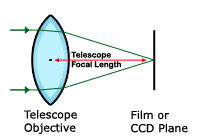
Prime Focus
 |
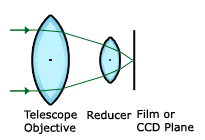
Focal Length Shortened by Using Reducer
 |
|
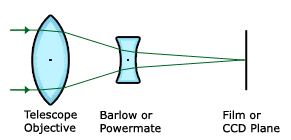
Focal Length Extended by Using Barlow/Powermate
 |
|
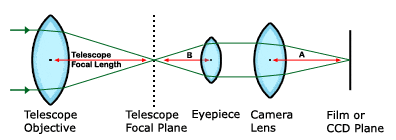
Focal Length Extended by Using Eyepiece Projection
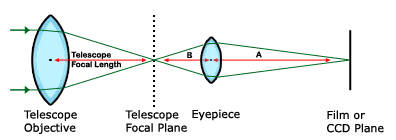
- Camera lens must be removed.
- Focal length extended by eyepiece acting as a relay lens
- f/# slowed by projection magnification
- Magnification of focal length determined by Relay Ratio (see diagram): Relay Ratio = A ÷ B
- focal length = Telescope Focal Length x (A ÷ B) Where A and B are determined from the formula:
Where F = eyepiece focal length1 = 1 + 1 F A B - Example with 600mm focal length (TV-85 telescope) using the Tele Vue Eyepiece Projection Adapter with Tele Vue 11mm Plossl eyepiece: if the Plossl is 12mm from Telescope focal plane and 150mm from Film or CCD Plane, the relay ratio is 150/12 = 12.5. 600mm x 12.5 yields 7500mm focal length
Afocal Imaging (Also Called "Digiscoping")
 Pic.1
Pic.1
 |
|
| Pic.2 | Pic.3 |
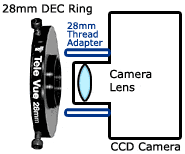
- Camera lens remains attached.
- Focal length of camera lens extended by telescope magnification where: magnification of Telescope = objective Focal Length ÷ eyepiece focal length
- Example: 600mm focal length telescope (TV-85 telescope) with 10mm eyepiece = 600/10 = 60x. If camera uses 50mm lens, above equation yields 3000mm focal length.
- An alternative way of determining effective focal length considers the camera lens and eyepiece combination acting as a relay system. Using the example above, the 50mm camera lens with the 10mm eyepiece gives 5x relay magnification. 5x600mm telescope objective focal length yields 3000mm focal length.
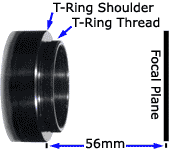
- Couple camera lens thread (Pic.2) or filter thread adapter (Pic.3) to Tele Vue digital adapter ring DEC-0028 (28mm), DEC-0037 (37mm), or DEC-0049 (49mm) directly (or if necessary with a step-ring) and digital adapter ring attaching to eyepiece in telescope focuser.
Choosing a method
 In general, for the widest fields, using a telescope, try Prime Focus. Note Reducers can increase fields but may introduce vignetting in large CCD chip sizes. This is usually compensated by "flat-fielding" during processing. (Flat-fielding in processing has no relation to optical systems such as reducers with field flattening correction for the curved fields produced by two- or three-element refractors.) For smaller fields, imaging portions of the moon, sun or planetary imaging, imaging with Powermates is very effective. (Some of the best published images use Powermate amplifiers). Afocal Imaging is ideal for nature photography as well as planetary imaging when long eye-relief eyepieces are used (to prevent vignetting). A wide power range is easily achieved using Radian, Panoptic, Plossl and Nagler eyepieces with at least 17mm eye-relief. See eyepieces recommended for digiscoping in Eyepiece Specifications table. Check out Tele Vue afocal adapters. Eyepiece Projection using Tele Vue Plossls is also capable of great magnification, but we believe this technique has been superseded by imaging with Powermates (in quality) and Afocal Imaging (in convenience).