 Your Browser is Outdated


Archery is the oldest form of hunting that is still in widespread practice today. Bowhunting was once the most effective way to get meat, and it still is for some isolated indigenous populations. Modern bowhunting in the rest of the world, particularly prevalent in North America, is actually to make hunting more challenging. Archery equipment isn’t as forgiving as firearms, and much closer distances are required to make the shot. Many bowhunters choose compound bows, and most compound bow hunters opt for specialized bow sights. As a result, sighting in your compound bow is a crucial component of bowhunting, as it helps ensure you hit your shots. This is not only critical when you get a new bow, but should be checked before you go out bowhunting. Of course, you should be putting in a lot of practice before bow season, so that’s just a reminder for the procrastinators.
What Kind of Bow Sights Are on a Compound Bow?
Many compound bow shooters prefer a rear peep sight that’s tied/twisted right into the bowstring, providing a better sight picture. If your new bow doesn’t come with a peep sight and you want one installed, this should be done by a professional in an archery shop. They may charge you a small fee, but it’s well worth it since trying to DIY things like cams and bowstrings on a compound bow can be pretty dangerous without the right equipment and expertise (there’s a LOT of latent power and dormant energy tied up in there). In the worst case, improper handling can snap the bow entirely.
The peep sight pairs nicely with the actual optic on a compound bow, with nearly all of them being pin sights. There are horizontal pins located in the sight housing, which is mounted on the bow’s riser above the arrow rest. A sight housing is usually round, making it more natural for the eye to be drawn to the middle, but there are some square or rectangular models out there. There are two main varieties of pin sights: single-pin and multi-pin.
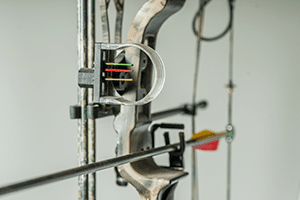 A single-pin sight is just that: it has one individual pin in the sight housing. To adjust for range, the entire sight is moved up or down in a vertical line, using a sight tape that indicates the right sight height for different distances in 10-yard increments. Since this can be a little slower out in the field, most compound bowhunters prefer a multi-pin sight.
A multi-pin sight usually has three to five pins in the sight housing. This makes it faster and easier to aim higher or lower almost instantly without adjustment after sighting in. Also in 10-yard increments, the closest distance is usually a 20-yard pin, located at the top of the row. Each pin below that represents a further range: 30-yard pin, 40-yard pin, 50-yard pin, and 60-yard pin on a 5-pin sight.
Where Do You Sight in Your Bow?
Sighting in your bow should be done in a safe location where you can ensure there is nothing behind your target that could be damaged (or injured, in the case of people and animals). There should be a sufficient backstop in case your arrow fully penetrates and passes through your target or in the event of a stray shot. Even though it’s unlikely that you’ll be taking shots past 80 yards, your range should be 100 yards long.
Remember, safety first! It’s a really bad idea to practice archery in a backyard if you live in a neighborhood. Even the greatest archers have a stray arrow once in a while, and if there’s even the slightest chance that it could go over (or through) a fence, you shouldn’t even consider it.
 Another consideration is the law: many cities and counties have restrictions against archery in populated areas. Some may allow you to have a backyard range only after it is inspected by officials and cleared for safety. Others ban it outright unless you’re at an archery range that has all of the necessary permits. Always check with your local law enforcement before practicing archery to ensure you’re not violating any laws or ordinances.
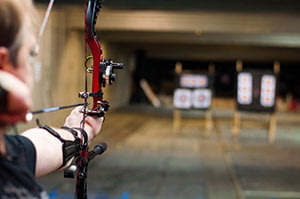
An archery range is tailor-made for sighting in your bow, and chances are good that there will be experienced archers and bowhunters there who will be more than happy to help you out with tips and pointers based on real-world experience. They’re set up for safety and in accordance with the laws. They’ll typically either have a membership program or some sort of daily sign-up. Don’t procrastinate and assume you can just walk in and start throwing arrows downrange. As bowhunting season creeps closer, archery ranges get booked up pretty quickly. It’s a good idea to get your foot in the door at least two months before bowhunting season so you can reserve slots for (at least) weekly practice sessions.
What Distance Should You Sight in a Compound Bow?
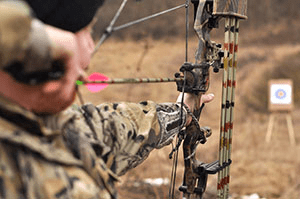 When you’re sighting in your compound bow and when you’re out bowhunting, using an archery rangefinder takes all of the guesswork out of distance. You may think you can eyeball-estimate range, but when compared to the rangefinder’s readout, you might be pretty surprised how inaccurate our judgment of distances can be. You’ll need a few bow tuning tools like Allen wrenches to adjust your pins, and you’ll want to use a level on the sight housing before getting started. You’ll also want to make sure there’s a straight line between the arrow rest and arrow nocking point on the bowstring.
Working in 10-yard increments, start by shooting using your top pin as a reference and at the closest distance of 10 yards. Use a big target with a big bullseye so that you can get an idea of how much adjustment needs to be made to each pin and to make sure your arrows are hitting the target even if the sights are way off. Move the sight pin up or down in the direction that the arrows are hitting. Once you’re confident that you have the right setting, move back 10 yards and repeat this, still using the top pin (20-yard pin). Once the 20-yard pin is dialed in, move back 10 more yards and adjust the next one down, the 30-yard pin. Once you’re confident at 30 yards, you guessed it, move back 10 more yards and set the 40-yard pin. Repeat this for the 4th and 5th pins down if you have a 5-pin sight.
Keep those Allen wrenches handy when you practice, as you’ll likely find the pin sights need minute adjustments as you improve. Even though an archery range usually has the lane distances taped out on the floor, you’re still going to want that rangefinder when you’re out bowhunting.
So there you have it, the simplest way to sight in your compound bow! You can shop for all of your archery products, including bow sights, recurve and compound bows, right here at OpticsPlanet! Happy hunting!


