Your Browser is Outdated



Sharing the View with Spotting Scopes
As a leader of bird groups and a birding guide, one of my favorite features of a bird spotting scope is its ability to share the view with others. With a binocular, the best you can do is point to a bird and hope everyone finds it in their binoculars. With spotting scopes, I can find the bird, lock the tripod head into position, then give everyone a chance to see the bird. A spotting scope also gives a "bird's eye view" of distinguishing and distinctive identification marks that can be difficult, if not impossible, to see in a binocular. Nothing like getting close enough with a spotting scope to actually see individual barbs on a feather. Wow! In the right hands, a spotting scope can be a great teaching tool and I nearly always carry a spotting scope on a tripod over my shoulder when leading a group.
Zoom Eyepiece
When you have a rare bird in the eyepiece of the spotting scope and are trying your best to thumb through a field guide to confirm the identity, all before the bird flies away, the last thing you need is to spend time changing the eyepiece on the spotting scope when you need more magnification. Remember, that bird in the eyepiece may be one you will not see, again, for years or perhaps never see again in your life and the sooner you can confirm an identification, the better. Seconds can count. A zoom eyepiece allows you to quickly zoom in as needed before the bird leaves.
That's the good news about zoom eyepieces. The bad news about zoom eyepieces is the cost. It is very expensive to make a quality zoom eyepiece. Why is this important? Contrary to what many beginners think, there is more to a spotting scope than the size or type of glass in the front (objective) lens. Truth is, the eyepiece on a spotting scope is as big or bigger a factor in image quality than the objective (front) lens of a spotting scope. After all, the eyepiece is half of the spotting scope! Cheap zoom eyepieces are notoriously poor in terms of image quality and ease of use with eyeglasses. If tempted to get by cheap and just upgrade to a better eyepiece, later, be warned that you do not have that option on inexpensive and even most mid-priced spotting scopes. Spotting scope eyepieces are NOT interchangeable between brands or even models within a brand. You may wish to read that, again. In other words, if the manufacturer does not list optional eyepieces for the bird scope model you select, you are stuck with the eyepiece supplied and, on inexpensive spotting scopes, that is almost universally an inexpensive zoom eyepiece. This means that, if you want a better eyepiece, you must buy a better spotting scope. Getting a different eyepiece is not an option until you get into more expensive spotting scopes.
When we move into more expensive spotting scopes, usually around $500, we begin to see optional eyepieces and also better zoom eyepieces as standard equipment. When given a choice between a fixed power eyepiece and a zoom eyepiece for birding, I still recommend the zoom eyepiece - a zoom is still the most versatile eyepiece. If you plan to take pics of birds by digiscoping (Digiscoping Update), though, a fixed power eyepiece is a better choice. Since I do both on every trip to the marsh, I carry both types of eyepieces for my spotting scope. If you cannot afford both, go with the zoom, since you can still use a zoom for digiscoping. Add the fixed power eyepiece as a second eyepiece.
As a last note on eyepieces, be careful when pricing. Many premium grade spotting scopes are sold as "body only". When you see "body only", it means just that. You still need to purchase the eyepiece as a separate item and add it to the price.
Spotting Scope Glass: To ED or not ED?
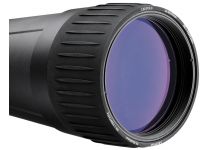 Fully multi-coated lens
ED, HD, APO, fluorite are special optical glasses that improve performance on a spotting scope by reducing or eliminating an optical defect called chromatic aberration (color fringing). As a result, an ED or other special glass spotting scope, will offer better image quality than the same model without ED. However, just adding an ED element to a less expensive spotting scope (a current market trend) will not turn it into a premium spotting scope. A poorly ground and polished lens is still a poorly ground and polished lens, regardless of the glass used. Then, too, placing an ED objective in front of a mediocre eyepiece is going to be a questionable improvement. Remember, the eyepiece is at least half the scope in terms of performance and image quality. When in doubt, price is always the best indicator of quality and performance in a spotting scope, not the presence of ED, HD and so on. A premium spotting scope with a standard glass lens and great eyepiece will easily outperform a less expensive model with ED.
Is going to an ED option on a given model of spotting scope worth it? That depends. You will see a difference with ED, HD and so on, visually, but only at higher magnifications above 40x or so. If you plan to use your spotting scope above 40x on a continuous basis and/or for tough bird groups like shorebirds, I recommend an ED option. For lower magnifications and/or easier bird groups, a standard lens is fine. On the other hand, if you plan to take pics (digiscope) with your spotting scope, going ED, HD and so on will make a difference in pic quality at any magnification. ED, HD and other special glass spotting scopes are highly recommended if you will be using your spotting scope with a camera.