 Your Browser is Outdated


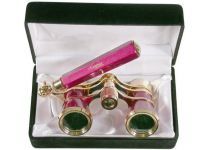
Opera glasses are some of the oldest binocular designs, dating back to the early days of opera, where opera-goers seated in the rear of an opera hall or in one the balconies or boxes wanted a close-up view of the performers and stage scenery. The original intent was to supply something small, unobtrusive, yet elegant and stylish. This remains the intended use for theater glasses to this day, though you can use opera glasses for other applications calling for a small, low power optical instrument. How are opera glasses different than a regular binocular? There are several differences in internal systems, focusing, appearance, and accessories. Read on to discover all you need to know to choose a pair of binoculars for operas, plays, and other entertainment events.
Internal Differences
Internally, opera glasses use a simpler optical system than conventional binoculars. This system is officially known as a Galilean optical system, since it is a very simple system similar to what Galileo used in his optical designs. The advantage of this type of optical system is both its simplicity and its very short optical length. This keeps the price down and also allows for a very compact design. The disadvantage of such a system is its lack of optical clarity and correction. If razor sharp optics is your goal, you are better served with a conventional, low-power binocular. Still, an opera glass can provide quite useful, pleasant views of the performers and the stage.
Today, nearly all opera binoculars are made in China and, in terms of optics, there is really no one brand or model that is significantly sharper than the rest. After all, this is not a system that is intended to produce razor sharp optics, no matter how well ground the lenses are. To be sure, there would be no point in investing high grade, expensive lenses in an optical system that cannot use them efficiently. The good news is that nearly any opera binocular on the market will be priced under $100. Your choice in terms of magnification is limited to 3x. Opera glasses have a standard measurement of 3x20 - 3x magnification with a 20mm objective (front) lens. Unless you are seated in a huge auditorium or concert hall, 3x is adequate magnification.
External Differences
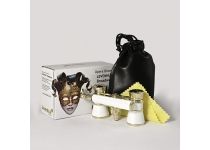
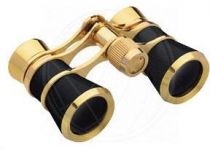
Externally, even a casual glance shows that binoculars for opera are also different than binoculars for more conventional uses. This reflects the tradition of elegance in the opera. Style and color are very much a personal preference but in today's market there is a color and style for nearly every taste.
Externally, there are also some options in terms of focusing. Opera glasses will either be no focus or center focus. Each optical system has advantages and disadvantages.
Focusing
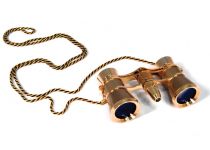
A no-focus opera glass, as the name suggests, requires no focusing whatsoever. Just look through these opera binoculars and everything is always in focus. Since there is no focusing mechanism, there is a program light, typically a small red LED, mounted between the barrels. A dim red program light, as shown in the image to the right, allows you to better read a program or find your way to your seat without interfering with your (or your fellow theater-goers') ability to see the stage. Unfortunately, a no-focus system is not the best if your eyes are bit old or in need of optical correction. In this case, you may want to consider a center focus model.
Center focus models allow a bit finer focusing, a good feature if you don't have the greatest eyesight or require a lot of correction. The downside is that there is no room for a program light on a center focus model. The center focus mechanism takes the place of the light on the no focus model as shown in the image below. This means that you must go with a no focus model if you want a program light on your opera glasses.
Opera Glasses Accessories
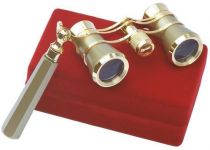
One nice extra, available on both no focus theater binoculars and a center focus opera glass is a lorgnette, which is an elegant way of describing the handle shown on the model to the left. This was originally added to an opera glass, not only to reduce fatigue, but also to more discreetly raise the opera glass in a crowd. Lorgnettes fold when not in use and most are adjustable for length. Opera glasses like the ones at the top of the page include an elegant lanyard to help keep them ready to use.
Nearly all opera glasses and antique opera glasses come with a velvet or leather case that closes with a drawstring to make them easy to carry. Some models offer the elegance of a hard, presentation style case. Both types of cases help protect the glasses from inclement weather and damage while traveling to and from the theater.
Can you use conventional compact binoculars or antique binocular at the opera? Yes, though conventional options may offer too much magnification if you are seated close to the stage, meaning it will have a much narrower field of view and be more difficult to hold steady. On the other hand, many contemporary opera halls and large venue concert auditoriums are much larger than a traditional opera house and an 8x binocular may be a better choice, especially if you are seated far off.
What about style and tradition? A conventional compact binocular, of course, won't typically give you those features, but you may want to think outside the box. A compact, cool-looking pair of low power binoculars in basic black with better quality lenses and a wide enough field of view delivers reverse snob appeal when you carry them with the right attitude. If you need a program light, you can probably use the one on your smartphone. Conventional compact, low-power binoculars are also more likely to be waterproof and more impact resistant for outdoor concerts.
OpticsPlanet carries vintage opera glasses and compact binoculars from reputable manufacturers such as Konus. Make us your choice for all optics, from antique opera glasses to modern binoculars.


