 Your Browser is Outdated


Customers frequently ask us how far they will be able to see with a certain optic. Unfortunately, there is no definitive answer to that question as there are many variables to consider, which we will cover in this guide. Hopefully, this information will assist you in selecting a sports optic that will work best for your specific application and allow you to see as clearly and far as you need.
Of course, what you will be able to see depends on what exactly you are looking at. If you are trying to see a 1-inch steel target at 1,000 yards, you may have a very difficult time, even with high-magnification scopes. If you were trying to see a vehicle at that distance, you would have an easier time. Even at much closer distances, a high-power rifle scope with a large objective and good glass clarity would allow you to better see the fine details of what you are looking at, compared to a low magnification scope with a smaller lens at the same distance. The bottom line is that you should know how far you intend to shoot, hunt, observe, etc., in order to make a better decision on the best optic for you.
Understanding Rifle Scope Magnification
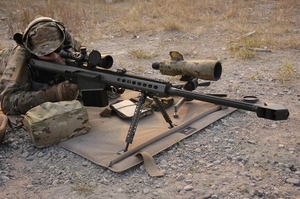 It's important to consider the magnification of your optic. A 1-8x scope, for example, has a magnification range of 1x to 8x magnification. While a 6-24x scope has a minimum magnification of 6x and a maximum of 24x. The higher the magnification an optic has, the better you will be able to see objects at a distance. Keep in mind, when using an optic at higher magnifications, you may have difficulty stabilizing as smaller movements become more pronounced at longer ranges. You will want to consider using a bipod, tripod, or shooting bag to help stabilize your rifle.
The objective lens of a scope, which can vary from 24mm up to 56mm, is how large the front glass of the scope measures. A larger objective lens means more light transmission and better clarity. If you had two scopes with the same magnification (4-16x), but one uses a 42mm objective and the other uses a 44mm objective, the 44mm scope would allow for more light transmission and a clearer image at full magnification. While both scopes have the same 16x magnification, the 44mm allows the picture to be clearer, which, in turn, lets you see further. Read our guide on Rifle Scope Magnification Explained to learn more about what the numbers on a scope mean.
Different Types of Rifle Scope Glass
Not all optics are made the same. Some manufacturers use higher-quality materials, most notably, the glass. Achromatic Glass and Apochromatic Glass are commonly used in magnified optics.
- Achromatic lenses usually allow two of the colors (red and blue) to intersect at the same focal point once refracted by the lens. This allows for a crisper, clearer image.
- Apochromatic lenses have three separate lenses put together to allow every single color to line up on the same plane.
These types of lenses have really sharp images with perfect color correction, providing the best clarity. On top of the type of glass used, coatings can be applied to the lens to reduce refractivity, making the image clearer and less distorted as there is less refraction when light goes through the lens.
Rifle Scope Lens Coatings Explained
Terms such as Coated, Fully Coated, Multicoated, and Fully Multicoated are used by the industry to determine how many lens surfaces are using an anti-reflective coating.
- Coated: At least one lens surface has a single layer of coating.
- Fully Coated: All surfaces have a single layer of coating.
- Multicoated: At least one lens surface has more than one layer of coating.
- Fully Multicoated: All glass surfaces have multiple layers of coating.
ED vs. HD Glass in Rifle Scopes
Manufacturers will also use different terminologies to label the glass used on their optics. Terms such as ED and HD are commonly used to provide basic information about the quality of the glass.
ED stands for Extra-Low Dispersion and uses a special compound called calcium fluoride to eliminate chromatic abbreviations caused by the lenses. ED glass will render a clear image of better quality while standard glass can create an image full of colorful fringes and deteriorate the resolution of the image, making it harder to focus on small details.
HD glass stands for High-Definition or High-Density and typically features fully-multicoated lenses that reduce glare and increase clarity. However, not every optic labeled as HD is a fully-multicoated optic. Some manufacturers use the term HD as a marketing term despite not being fully multi-coated. Both ED and HD lenses are better than standard lenses and will provide better resolution, clarity, and image sharpness.
Explore Other Optics Today!
There are other means to assist you in seeing further and more clearly than just rifle scopes. High-powered binoculars, spotting scopes, and cellular trail cameras are common ways to view targets at long distances. Spotting scopes use a much larger objective lens and even more magnification. The same logic applies to them as well. The larger the objective, the more light transmission and clearer your image will be at higher magnification.
Certain people may also have vision issues that can restrict their ability to see clearly. Terrain and weather conditions will also play a role in your max viewing distance. Therefore, there is no way to objectively state how far you will be able to see with any given optic. If you want to see as far as possible, the best way to go about selecting an optic would be to choose one that has a very large objective lens, high-quality glass, and high magnification. Understanding the differences in optic features and knowing an appropriate budget for your application will help you choose the best optic for your needs. Browse all our Rifle Scope Guides to learn more about buying the best scopes based on your needs and budget.

