 Your Browser is Outdated


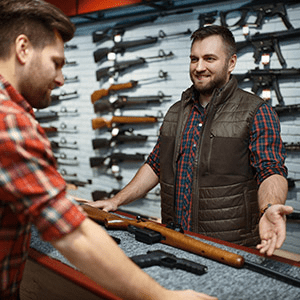 Buying your first gun can be both exciting and intimidating. You’re probably wondering, "What is the first gun to buy?" or "What is a good first handgun?" There’s a wide variety of firearms out there, and if you’re reading this, then you’re probably not entirely sure what’s best for you.
Just remember, when it comes to guns, there really are no stupid questions no matter what your experience level is. It is far better to get all of your questions answered upfront so that you can safely handle whichever gun you decide is best for you.
What’s the Best First Gun to Buy?
It’s best to think of guns like shoes: there’s no one-size-fits-all and nothing’s universal for all purposes. You wouldn’t wear stiletto heels out hiking, and you wouldn’t wear your hiking boots to a black-tie gala. Well, maybe you might try, but it’s probably not an experience you’ll care to repeat. On the same note, the shoes that comfortably fit one person are not a guaranteed fit for the next. A good first handgun for a friend or family member is not necessarily going to be right for you, although it may be once you’ve done your research and whittled down your choices.
The best first firearm to buy is one that’s appropriate for your intended use. If you plan on going hunting, you’ll have different considerations and different guns you’ll need depending on what you’re hunting (check out our tips for the Best Hunting Guns). If you’re looking for self-defense, is it primarily for everyday carry (EDC)/concealed carry or home defense? Even though you’ll be target practicing with any gun you get, maybe you’re just interested in target shooting and aspiring to get into competition someday. These are the first things you need to ask yourself when you start shopping for a gun. This will begin to steer you toward a handgun, rifle, or shotgun and what caliber to choose.
Types of Guns
There are 2 basic types of firearms: long guns and handguns.

- Pistols can be fired with one hand, have no shoulder stock, and usually have barrels of 10 inches or less. Handgun action designs include revolvers, semiautomatics, and some single-shot models that are offered for either personal defense or precision target shooting. All handguns can also properly be called "pistols," although people will try to convince you otherwise. The fact is that they’ve been called that since the mid-16th century, and the terms are interchangeable.
- Long guns are rifles or shotguns. They have a shoulder stock and a barrel of at least 16 inches, with a total overall length of 26 inches or more to be compliant with the NFA (National Firearms Act). A shotgun’s barrel is smooth inside, and a rifle has grooves called "rifling" that twist down the inside of the barrel to improve accuracy (pistols also have rifled barrels.)
The Differences Between Hunting, Concealed Carry & Target Shooting Guns
Guns fall into 3 primary uses: hunting, self-defense/tactical, and target shooting. Long guns and handguns are used for any and all of these applications, but the design of the gun will dictate what it’s best for.
Hunting Guns
- Have longer barrels for accuracy
- Have lower capacities than self-defense guns
- Usually overall larger and heavier than defense guns
- Tend to be manual actions (break, bolt, lever, pump) rather than semi-auto, although there are several semi-auto models purpose-built for hunting
 Self Defense & Home Defense
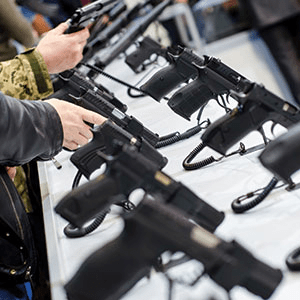
- Everyday carry (EDC) pistols are usually smaller for concealment while designed to hold as many rounds as possible
- Home-defense long guns have short (16 to 20 inch) barrels for maneuverability in tight quarters
- Usually more lightweight than other designs for easier carrying
Target Shooting
- Design focused on highest accuracy, so may be heavy or unwieldy for carrying
- Usually specific to certain disciplines or competitions like long-range, 3-gun, cowboy action, etc.
No matter what the primary design of your firearm is, you need to practice with it. This can be at an indoor or outdoor range, in addition to using dry-fire training at home. Hunting guns are typically used only a few times a year, target gun use depends on your level of interest, and defense guns are used the very least but need the most practice so that you’re ready to use them effectively if and when the time comes.
Shopping Tips When Buying Your First Gun
Okay, so you’re heading out to buy your first gun, rip-raring and ready to go. Your money is burning a hole in your pocket, and you can’t wait to get your hands on the first firearm you’ve ever owned. Although it can be very exhilarating, there are a few things to bear in mind. As a former clerk and a constant customer many times over, I’d suggest you consider the following:
- Demonstrate proper firearm safety practices. People behind the gun counter unfortunately have folks inadvertently point guns at them, but you never get used to it. If you’re behaving in a wildly unsafe manner, they’ll probably ask you to leave. Remember, just because you have a legal right to buy a gun doesn’t mean they forfeit their right to refuse service.
- If you’re considering a new vs. used gun, there are pros and cons to both. A new gun costs more but won’t have any concerns about condition or wear. A used gun will cost less but may have unseen issues that even the seller doesn’t know about, and used guns aren’t often covered by any warranty (except recall notices).
- Don’t buy the first one you look at. It may be tempting, but there might be something better for you right around the corner. If you can stand it, go home and sleep on it. Due to safety concerns, most retailers will not do an exchange or return on any gun. If there’s a warranty issue, they’ll help you get it to the manufacturer, but once you’ve bought it, you own it. If you have buyer’s remorse, you’ll have to sell it and go buy another one.
- Once you’ve checked a few out and are pretty sure of what you want, go to a shop or shooting range that rents that model (or one that’s really similar). If you’d test-drive a car, you should test-drive a gun.
- As you’re handling different guns, work the action and any controls, buttons, or levers that it has. Are they too complicated for you? Is it difficult for you to work the action or any other components? If so, it’s time to move on to the next one.
- Don’t be too rigid and be open to other ideas once you’re actually handling different makes and models. If you get your heart set on something that turns out to be a bad fit, it can be disappointing, but you’ll be better off in the long run.
- Don’t pretend that you know more than you do. It’s okay to be new to anything, and we may want to overcompensate for that. This can lead to some false assumptions on the clerk’s part, and they may give you options that aren’t what you’re looking for.
- Price is important. The cheapest gun on the wall is priced that way for a reason. On the other side of the same coin, you don’t need the most expensive gun on the wall, either. As you browse, take note of the average price of similar models and stay in that range.
- Speaking of prices, what about ammunition? Go with a common caliber that is easy to find and relatively inexpensive. Rare calibers are really cool, but leave that sort of thing for future purchases. If you can't afford ammo or find the right caliber in stock, a gun isn’t much more than a paperweight.
- Be prepared to spend more than the sticker price of the gun. Guns are like Barbie Dolls—the accessories are endless. You don’t need every doodad and geegaw on the market just to get started, no matter what the salesman says.
- For a concealed carry handgun, you’ll need a box of pretty pricey defense-specific ammo (20 to 50 cartridges) and a few boxes of relatively inexpensive practice target ammo (100 to 500 cartridges).
- For a hunting rifle, you’ll really only need two identical boxes (usually 40 total rounds). Make sure they’re identical so that they perform correctly in the field after you have them sighted in. Remember, you’re not going to be doing high-volume shooting with a hunting rifle, and these two boxes may well last you up to a decade.
- For a shotgun, well, there’s a reason they sell boxes by the case (10 boxes = 250 shells).
If it’s a defense gun, you’ll want a box of defense shells (typically 5 to 20 rounds) and at least two boxes of practice shells (50 rounds).
Hunting shotgun shells come in a wide variety depending on what kind of game you’re after. Ask your hunting buddies, and they’ll give you a good estimate of how much you’ll need. Waterfowlers usually have one box or two boxes per day of hunting. Deer hunters rarely have more than five slugs or buckshot shells. Upland and small game hunters can usually get by with four boxes (100 shells) per season, but a lot of us are stocked up with at least twice that amount. The bag limit usually determines how many shotgun shells you need for any given hunt, and you have to account for missing a few shots.
Clay target shotgunners buy by the case and often multiple cases at a time. It’s really, really fun, and there’s no bag limit.
- You need to have ear protection and eye protection; it’s not negotiable. Ranges won’t allow you to shoot without them, and you shouldn’t anyway. You only get one set of eyes and ears, and there’s no reason to squander them needlessly.
- If you’re buying a hunting rifle, you’re most likely going to want a scope. For a quality optic, plan on spending at least half of the cost of the gun up to an equal amount. Yes, this can mean you’re spending $500 on a rifle and $500 on a scope, but that pays off in performance. You may only get one shot out in the field each season, and a decent rifle will easily last you at least 10 years. That comes out to $100 a year, and believe me, you’ll spend more than that on gas and snacks when you go hunting.
- You will need ammunition and a gun cleaning kit no matter what firearm you buy. How much ammo you buy depends on what you’re doing with your gun. Keep in mind that when you’re practicing or target shooting on the range, you’ll burn through 100 rounds of anything but hunting rifle ammo in no time at all.
- For a handgun, you’re going to need a holster tailored to your intended carry method and specifically fitted for the size and shape of your gun. For a hunting rifle, you’re going to want a shoulder sling. For a shotgun, a sling is nice but not usually considered a necessity.
- If you’re buying a defense gun, you may want to look at adding a weapon light, laser, and/or red dot sight. These can be somewhat expensive, but a lot of buyers see that as acceptable since they’re planning on needing it to work flawlessly in an emergency.
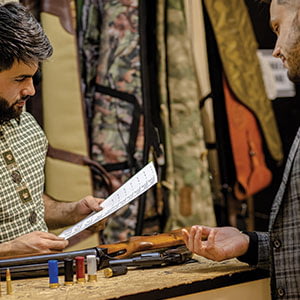
- Don’t expect to walk in and out of the store in a matter of minutes. Buying a gun has a lot of processes, and that can take a while. 30 minutes is a bare minimum, on a slow day, with a very experienced salesperson at the helm and a customer who’s very used to buying guns. Stores have to check and double-check serial numbers, run background checks on 4473s, follow their own inventory processes, and quite frankly, anyone who is in a big rush to get a gun and get out in a hurry raises some red flags.
- You need safe storage. It doesn’t matter how safe your neighborhood is, how much you trust the people you live with, if you live alone, or if you live out in the sticks, you need a way to secure your gun. This can be as simple as a gun lock, a quick-access lockbox, or a gun safe. Ask your salesperson to show you some gun storage options once you’ve settled on the gun you’re buying for sure.
Ready to Buy Your First Gun?
It’s a big deal and a lot of fun but nothing to take lightly. Some people will buy one gun, and that’s all they want or need for the rest of their lives. Some will find that they want to expand into other shooting sports and will definitely wind up buying two or three more. Some will become collectors and find themselves zeroing in on a particular kind of gun. And some, like yours truly, have a different gun for just about any occasion and some antiques that will never be fired again. So get educated, figure out what type of gun you want, and no matter what you buy, practice, practice, practice. Check out our other guide on 4 Tips for First-Time Gun Buyers, and when you’re ready to tune it up or expand your accessories, check out everything OpticsPlanet has to offer!


